

Stop Wasting Energy: How Smarter Pumping Schedules Can Cut Operating Costs Without Losing Production
For decades, many beam-pumped wells have been operated the same way—running 24 hours a day, seven days a week. But what if a well doesn't actually need to pump continuously?
A classic 1999 paper from Echometer and the University of Texas demonstrated that many stripper and marginal wells can significantly reduce operating costs simply by pumping less—without sacrificing production. While the technology has evolved dramatically since then, the principles remain highly relevant today.
The Hidden Cost of Over-Pumping

More than 400,000 beam-pumped wells in the United States were estimated to have pumping systems capable of producing more fluid than the reservoir could actually deliver. In these cases, continuous pumping provides little benefit once the well has been pumped down. Instead, the pump begins operating with only partial fluid fillage, causing it to "pump off."
This leads to several costly problems:
Higher electricity consumption
Increased wear on rods, tubing, and pumps
Excessive vibration and shock loading
More frequent maintenance and equipment failures
Rather than increasing production, continuous operation often accelerates equipment wear while wasting energy.
A Simpler Solution: Pump Only When the Well Is Ready
The paper evaluated two methods of reducing unnecessary pumping:
Pump-Off Controllers (POCs), which automatically monitor well conditions and stop pumping when the pump is no longer full.
Simple on/off timers, which periodically shut the pumping unit down to allow the well to refill before restarting.
Both approaches aim to keep the pump operating with a full barrel rather than repeatedly pumping an empty well.
Why Timers Can Deliver Big Savings
One of the paper's most interesting conclusions is that an inexpensive timer can provide substantial savings on many low-production wells.
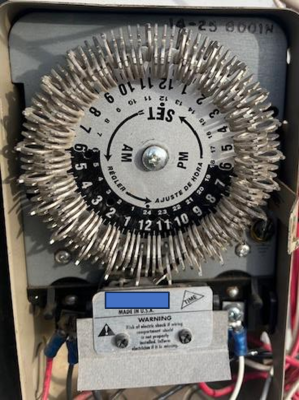
The authors recommend a 15-minute operating cycle, adjusting the run time so the pump operates only as long as it remains efficiently filled with fluid. Once the well has been pumped down, the unit shuts off and allows reservoir fluids to accumulate before restarting.
The result is:
Lower electrical consumption
Reduced peak demand charges
Less mechanical stress
Longer equipment life
The Case Study
The paper documented a field trial on a beam-pumped well that had severe gas interference and poor pump fillage.
After installing an improved gas separator and setting a 15-minute timer to run approximately one-third of the time:
Oil production increased slightly.
Water production remained stable.
The monthly electricity bill dropped from $203 to $108.
Overall electrical efficiency improved from 35% to 59%.
The projected payout for the modifications was only eight months, based on reduced energy and maintenance costs.
Perhaps even more important, the pumping unit operated much more smoothly because it spent most of its run cycle pumping a full barrel instead of repeatedly pumping off.
The Importance of Proper Timer Settings
A timer is only effective when it is correctly adjusted.
The authors recommend using dynamometer cards or other well diagnostics to determine how long a well can pump efficiently before fluid levels decline. Wells should also be checked periodically because reservoir performance changes over time.
This highlights one of the limitations of traditional timers: they cannot automatically adapt to changing well conditions.
From Fixed Timers to Intelligent Automation
When this paper was published in 1999, operators had two primary choices:
Install a low-cost timer.
Invest in a more expensive pump-off controller.
Today, advances in low-cost sensors, wireless communications, cloud computing, and AI have created a third option.
Modern well-monitoring systems can continuously observe pumping behavior, detect changing conditions, and recommend—or automatically adjust—the optimal pumping schedule without requiring expensive legacy control systems.
Telemetry Insight’s WELLTEMPO is a cost-effective way to achieve optimal results utilizing existing control equipment such as timers. It measures and reports pump off conditions continuously with a small solar powered and self-contained unit mounted on the walking beam.
Instead of relying on manual measurements via periodic field visits, operators can monitor wells remotely and optimize run times as reservoir conditions evolve.
The Takeaway
The core lesson from this paper is just as relevant today as it was more than 25 years ago:
Running a pumping unit longer does not necessarily produce more oil.
For many marginal wells, intelligently matching pump run time to reservoir inflow can:
Reduce electricity costs
Extend equipment life
Lower maintenance expenses
Improve operating efficiency
Maintain—or even slightly improve—production
While today's technology enables far more sophisticated optimization than the timers described in the original study, the underlying principle remains unchanged: pump only when the well has fluid to produce.


Comments